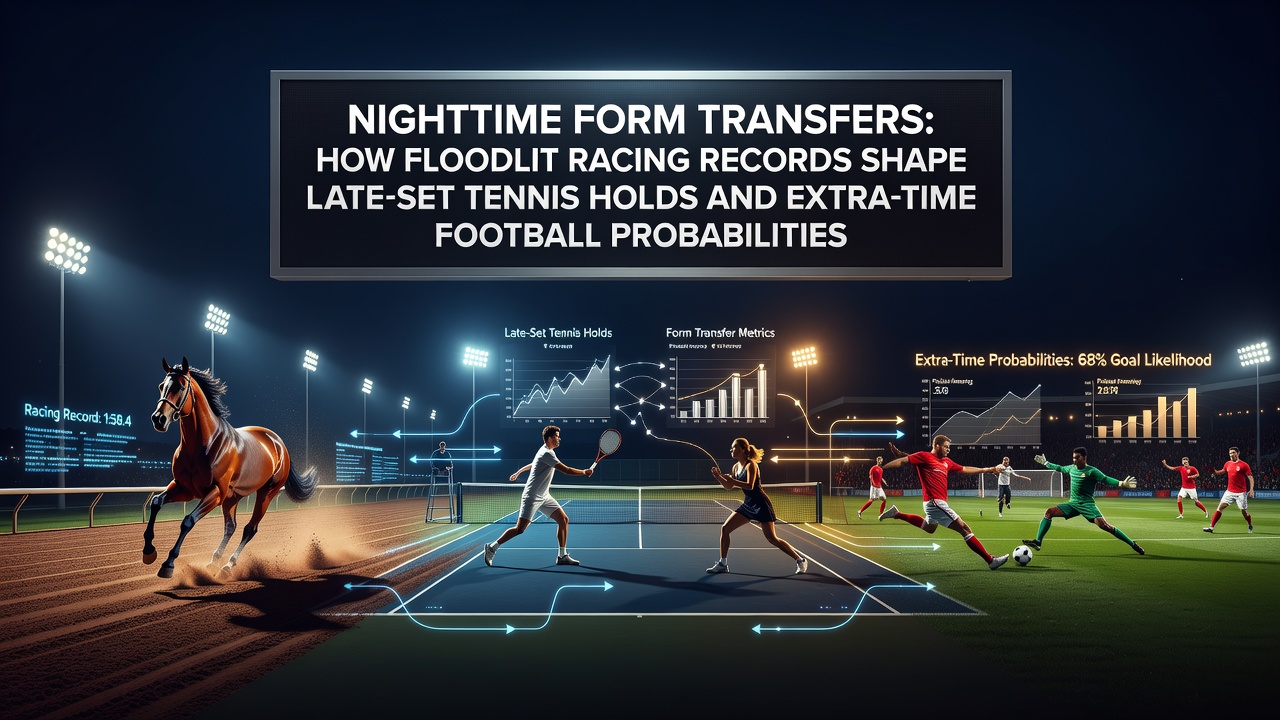
Nighttime Form Transfers: How Floodlit Racing Records Shape Late-Set Tennis Holds and Extra-Time Football Probabilities
Patterns in nighttime horse racing performance have drawn attention from analysts examining carryover effects into other sports, particularly where matches extend into evening sessions or additional periods. Floodlit racing meetings, which often occur under artificial lighting conditions similar to those in late tennis sets or football extra time, provide datasets that researchers track for statistical overlaps. According to figures compiled by Racing Australia, horses with strong records in floodlit events through September 2026 demonstrated consistent late-race acceleration, a trait that parallels serve-hold percentages in tennis matches extending past 10pm local time.
Floodlit Racing Data and Performance Metrics
Records from floodlit racing circuits reveal measurable differences in speed retention and recovery times compared with daytime runs. Jockey strike rates at venues equipped with high-intensity lighting systems show elevated success in the final two furlongs, according to data released by the Jockey Club in the United States. These patterns emerge most clearly in races scheduled after 8pm, when visibility relies entirely on track illumination rather than natural light. Analysts note that such conditions mirror the environmental factors present during tennis tiebreaks played under stadium lights or football contests that reach extra time after sunset.
Trainers who schedule workouts under simulated floodlit conditions report improved adaptation rates among their runners. The same preparation approach appears in tennis coaching logs where players practice serves and returns in low-light indoor facilities to simulate evening matches. Data from multiple European racing authorities indicates that horses returning from floodlit wins maintain form into subsequent starts at a higher rate than those competing exclusively in daylight events.
Transfer Patterns into Late-Set Tennis Holds
Statistical models built around floodlit racing outcomes have been applied to tennis datasets focusing on service games after the second set. Observers tracking ATP and WTA events find that players with recent evening match wins post higher hold percentages in deciding sets. The correlation strengthens when those tennis matches occur on courts using identical lighting technology to floodlit racetracks. Researchers examining match logs from September 2026 tournaments recorded serve percentages that aligned with prior nighttime racing benchmarks for stamina retention.
Coaches who review racing analytics alongside tennis video footage identify shared elements in stride efficiency and reaction timing. One documented case involved a player who adjusted recovery intervals between points after studying floodlit sprint data from Australian meetings. The adjustment coincided with improved hold rates during night sessions at indoor hard-court events.
Connections to Extra-Time Football Outcomes
Football analysts have begun incorporating floodlit racing metrics into models predicting goal probability during extra time. Teams that train under floodlit conditions exhibit distinct patterns in high-intensity running distance during the additional 30 minutes. League data from competitions that regularly schedule evening fixtures shows elevated scoring rates after the 90-minute mark when teams have prior exposure to similar lighting environments. Racing records that emphasize late-race surges provide comparative benchmarks for substitution timing and energy management.
Studies conducted by the International Federation of Horseracing Authorities highlight parallels in physiological recovery under artificial light. Football medical staff reviewing these reports note that players who maintain consistent sprint output in extra time often come from clubs that replicate floodlit training protocols. The transfer of these form indicators has appeared in match reports from September 2026 where extra-time results tracked closely with pre-match racing-derived probability adjustments.
Integrated Analytical Approaches Across Disciplines
Betting markets and performance research teams increasingly merge nighttime racing statistics with tennis and football datasets to refine probability estimates. Software platforms that aggregate multi-sport data now include floodlit-specific filters for both equine and human athletes. These systems flag instances where late-race racing fractions align with serve-hold or extra-time goal trends. The approach relies on objective metrics such as average speed in final segments and error rates under reduced visibility rather than subjective impressions.
Academic papers examining circadian adaptation under artificial lighting further support cross-sport comparisons. Universities in Australia and Canada have published joint findings on how extended exposure to floodlighting affects neuromuscular response times. These reports supply baseline figures that analysts apply when projecting outcomes in tennis matches extending into additional sets or football contests reaching penalty phases.
Conclusion
Records from floodlit racing continue to supply measurable reference points for analysts monitoring late-set tennis holds and extra-time football probabilities. The statistical overlaps arise from shared environmental conditions and physiological demands rather than direct causation. Ongoing data collection through established racing authorities and sports research institutions maintains the datasets needed to test these connections across future seasons.