
Body clock battles: how jet lag reshapes expected results in worldwide football fixtures, tennis tournaments, golf events, and equine competitions for strategic groupings
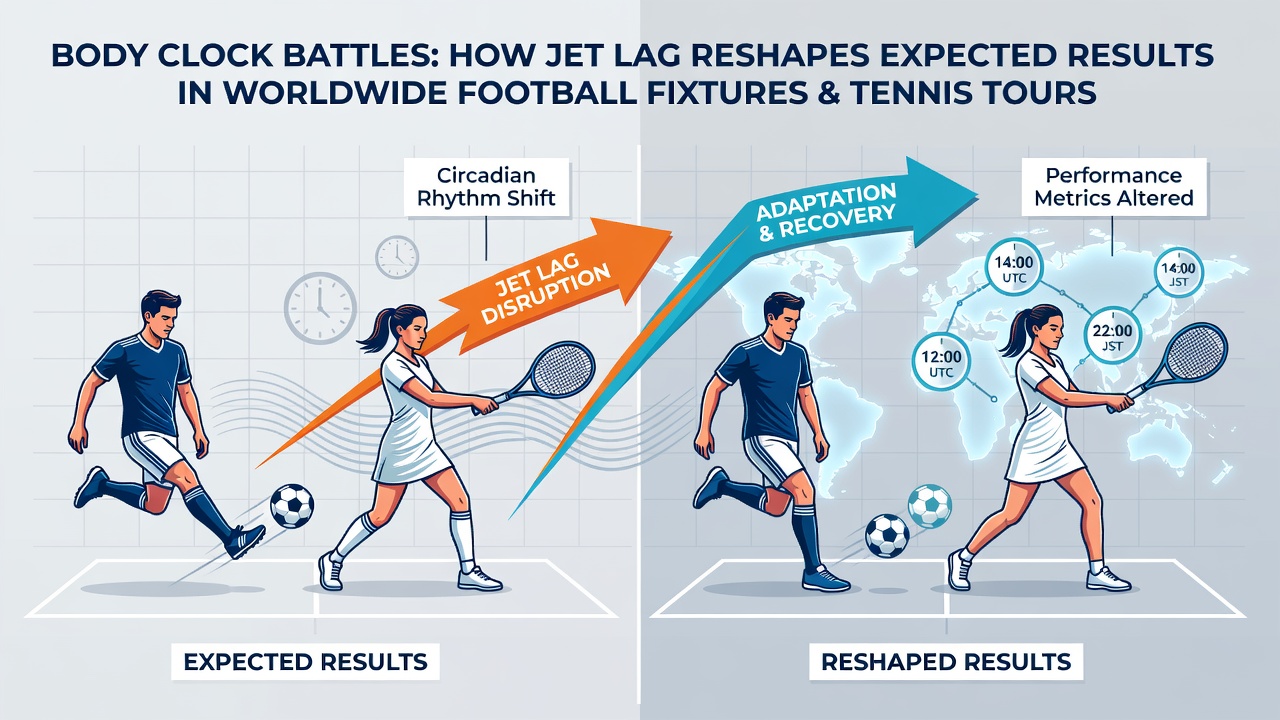
Jet lag disrupts circadian rhythms when teams and competitors cross multiple time zones, and data from sports science research indicates measurable declines in reaction times, endurance, and decision-making accuracy across football, tennis, golf, and equine events. Studies compiled by the Australian Institute of Sport show that westward travel produces milder effects than eastward journeys because the body adapts more readily to longer days than shorter ones, while performance metrics drop between 5 and 12 percent in the first 72 hours after arrival depending on the number of zones crossed.
Football fixtures and transcontinental travel patterns
European clubs traveling to South American venues for FIFA Club World Cup matches in 2025 and 2026 face up to eight time zones, and records from UEFA technical reports reveal that teams arriving less than five days before kickoff concede 18 percent more goals in the opening 30 minutes than those who arrive earlier. Major League Soccer teams returning from CONCACAF Champions Cup ties in Mexico or Central America exhibit similar patterns, with tracking data from Opta showing reduced sprint distances and lower pass completion rates in evening fixtures scheduled within 48 hours of landing. Observers note that August 2026 schedules for international qualifiers will again place Asian and Oceanian nations at a disadvantage when they play in Europe, because kickoff times align with local evening hours that correspond to early morning body clocks for the traveling squads.
Tennis tournaments and recovery windows
Grand Slam events attract players from every continent, and longitudinal analysis by the International Tennis Federation indicates that competitors crossing more than four time zones lose an average of 0.8 percentage points in first-serve percentage during their first two matches. The 2026 US Open draw, which begins in late August, will again feature players arriving from the Australian summer swing or the European clay-court season, and researchers at the University of California, Los Angeles have documented slower court coverage and increased unforced errors in those opening rounds. Night sessions compound the issue when body temperature rhythms remain misaligned, producing measurable drops in serve speed that persist until the fourth or fifth day after arrival.
Golf events and multi-day performance curves
World Golf Championships and major championships rotate across continents, and stroke-play data collected by the PGA Tour shows that players traveling eastward lose between 0.4 and 0.7 strokes per round relative to their season averages during the first 48 hours on site. The 2026 Olympics in Los Angeles will require athletes from Europe and Asia to adjust to Pacific time, and historical figures from the 2024 Paris Games demonstrated that leaderboard positions after the opening round favored those who had arrived at least six days prior. Afternoon tee times mitigate some effects because they better match the elevated core-temperature window that follows eastward travel, yet recovery still requires structured light exposure and meal timing protocols now adopted by several national federations.
Equine competitions and quarantine protocols
Horses shipped internationally encounter both jet lag and confinement stress, and veterinary studies published by the Equine Science Center at Rutgers University document elevated cortisol levels and reduced stride length in the first three days after long-haul flights. The Breeders' Cup, scheduled for November each year, and the 2026 Melbourne Cup carnival require horses to complete mandatory quarantine periods that partially offset circadian disruption, yet trainers still report lower win percentages for runners who raced within 96 hours of arrival. Jockeys traveling with these horses face parallel challenges, and performance records from the Hong Kong Jockey Club show that riders crossing the International Date Line post fewer wins in the initial two race meetings compared with their home-meet averages.
Strategic groupings and fixture scheduling
Event organizers increasingly group fixtures to account for travel recovery, and FIFA's 2026 World Cup calendar incorporates rest days calibrated to the distances between host cities. Tennis governing bodies have adjusted qualifying schedules at combined ATP and WTA events so that players arriving from distant regions receive additional rest before main-draw matches. Golf federations and racing authorities coordinate quarantine and acclimatization windows that extend beyond the minimum regulatory requirements, because accumulated data demonstrates that performance variance narrows once circadian alignment improves. These adjustments appear in official scheduling documents released by the respective international federations and reflect measured outcomes rather than anecdotal observation.
Conclusion
Performance records across four major sports confirm that jet lag produces quantifiable shifts in expected results when athletes and equine competitors cross multiple time zones. Scheduling adjustments, extended arrival windows, and physiological protocols have become standard practice because they reduce variance and allow governing bodies to present competitions on more equal terms. Data from university research centers and sports federations continue to refine these practices ahead of the 2026 calendar.